
I Signed Up to Keep Going. I Left With a Portfolio.
by Vanessa Nagamine, Mixed-Media and Textile Artist, Rise and Repaint Member
When Rise and Repaint announced its virtual residency program, offering a month of dedication and focus on artwork for the members of our community of women and non-binary artists, curators Liezel and Pegah provided a prep checklist. It included a prompt for reflection: how do you want to use the residency to improve the stage your work is currently in? We received a form that helped us reflect on our practice and current career stage, categorized into the types of residencies that would be most useful to us. These included categories like Researching Residency, Exhibition Residency, and Documentation Residency, among others, as well as the option to create our own custom residency format.
I found myself in a dilemma: would it be better at that moment to keep creating new pieces for my fabric comic series I AM NOT A ROBOT, or should I invest that collective studio time into documentation, building my website and portfolio? Alternatively, since I would have peers to work with during the residency, I could experiment with new techniques by tapping into their expertise.
Unable to decide on my own, I turned to the community and posted my dilemma in our Circle group. The best part of being in a community with artists from all over the world, each with unique perspectives and backgrounds, was receiving feedback that helped me organize my vision regarding where my work stood.
I ultimately chose what I nicknamed a "Keep Going Residency," dedicating most of my time to creating more pieces for the series I am currently developing.
However, to my surprise, I experienced a major breakthrough over the course of the residency. I did make new pieces, but I also ended the month with professional photo documentation, a website, and a portfolio. All ready to present my art professionally for open calls and other residency applications.
Thanks to the guidance and resources provided during the RR Virtual Residency, I achieved results far beyond my initial expectations, all within an environment of creative freedom, deep respect for my process, and total support.
The Magic of the Breakout Room
by Rosie Fitzgerrel
Landscape and Figurative Painter & Rise and Repaint Member
by Rosie Fitzgerrel, Landscape and Figurative Painter, Rise and Repaint Member
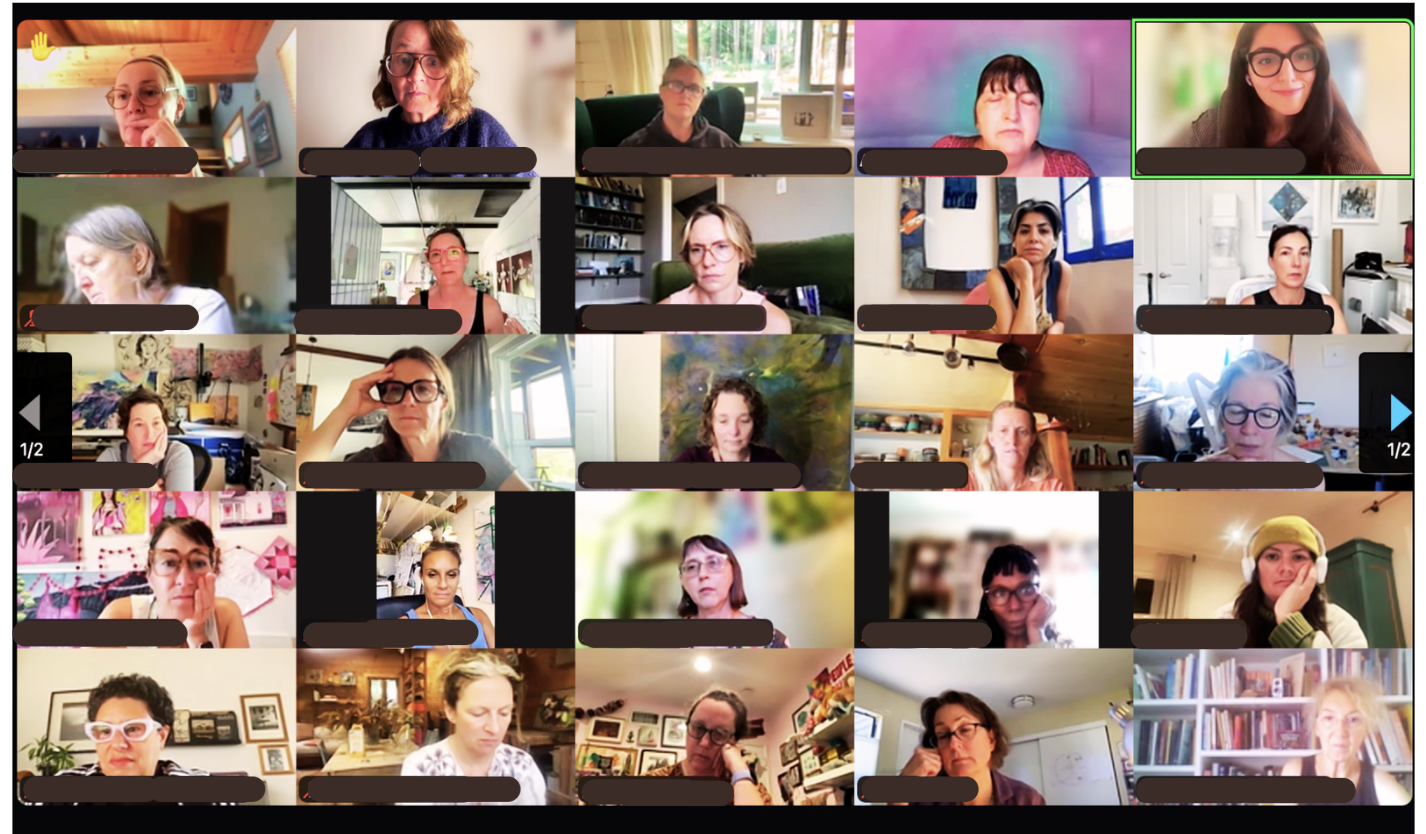
When I first joined the Rise & Repaint Network, Pegah and Liezel were so warm and welcoming. I could tell right away that they fiercely believed in all of their members, the female and non-binary artists who have been sidelined from the art world for centuries. They were going to arm us with the knowledge and confidence to navigate the mercurial art world, and I was going to be an ace student. The topics they present are varied, interesting, and important, and I look forward to every session. But truly what I most enjoy are the breakout rooms.
Discussions may spill over to the network or to Instagram. You get to know one another, celebrate each other's successes, and bolster each other through the failures.
The breakout room is where the magic happens. After the topic presentation that is packed with new information, it may not be immediately clear how to best apply it to your own practice. In the breakout room, you virtually meet with two or three other artists for 10 minutes after the main topic to discuss and bounce ideas off one another. Sometimes I may be feeling stuck while another artist is buzzing, and they help me see the path forward. Other times we’re all animatedly talking about the topic, passing it back and forth like a ping pong ball. It’s where we get to pull the topic apart and put it back together, custom fit for our own way of working.
Breakout room is more than just a one-time conversation. Showing up weekly means you are building genuine relationships with other artists.
It's where we get to pull the topic apart and put it back together, custom fit for our own way of working
I know that comfortably talking with strangers is not most artists’ inclination. Many of us are introverts and are happiest in our studios with tools and materials in hand, in quiet communion with our work. The networking part required of us does not come naturally.
So yes, you have to speak in a room of strangers. But all of those strangers are artists. There's an inherent understanding built into these breakout rooms. Even though I live in Tennessee and I'm in a breakout room with an artist from South Africa and another from Ireland, we're all facing similar challenges because we're all rooted in a creative practice.
Even though I live in Tennessee and I'm in a breakout room with an artist from South Africa and another from Ireland, we're all facing similar challenges because we're all rooted in a creative practice.
But the breakout room is more than just a one-time conversation. Showing up weekly means you are building genuine relationships with other artists. Discussions may spill over to the network or to Instagram. You get to know one another, celebrate each other's successes, and bolster each other through the failures. Maybe you even show up to support one another in person.
And eventually, even though each breakout room pulls together a random group of artists, over time you may find yourself in rooms where you already know everyone. Suddenly, no one is a stranger. You all know each other's work, the ages of each other's kids, how many dogs everyone has. Instead of introductions, you’re asking, “How did the opening go? The pictures looked amazing!” or “Did you figure out where to buy that material? I saw some in my local store, maybe I could mail it to you!” Now you’re just catching up with the friends you haven't seen in a few days.
The Rise & Repaint Network is a community, and the cornerstone of that are its breakout rooms. So if you haven’t joined before, I encourage you to give it a try and experience the magic of community for yourself.